
Microlandia
Microlandia 1.8: Tourists are not a number
Every other city-builder treats tourism the same way. A passive income stream, a number on a spreadsheet, a reward for placing pretty things near other pretty things. Tourists arrive, money appears, nobody asks where they sleep. Version 1.8 kills that fantasy. Tourists are now real visitors with budgets, hotel preferences, and the bad habit of not showing up when your city has a pandemic or nowhere to put them. We also rebuilt the rent market from actual urban economics, added a second region four times the size of the original, overhauled how happiness works, and gave you four new languages to ignore your citizens in.
Tourism becomes a full industry
Tourists used to be ghosts. They arrived as a monthly lump sum, boosted a number, and vanished. Now they are people with wallets. They check into hotels, stay for three days, spend money at shops and casinos, and leave. If your hotels are full, the tourists do not come. The simulation does not invent beds for them.
- New building: Hotel. A 2x2 block that holds 50 guests. The old hotel is now the Boutique Hotel (20 guests). You need both.
New building: Convention Center. A 4x5 gift-box reward. $200M to build, five years of construction, 100 points of tourism aura, $500k monthly to keep the lights on. It is a money pit that prints visitors. - Tourism aura reworked. Each point of aura attracts one tourist per day. Tourists spend about $400 daily at retail and hospitality businesses around town. More aura, more tourists, more spending, more tax revenue. Or more empty hotels, if you got it wrong.
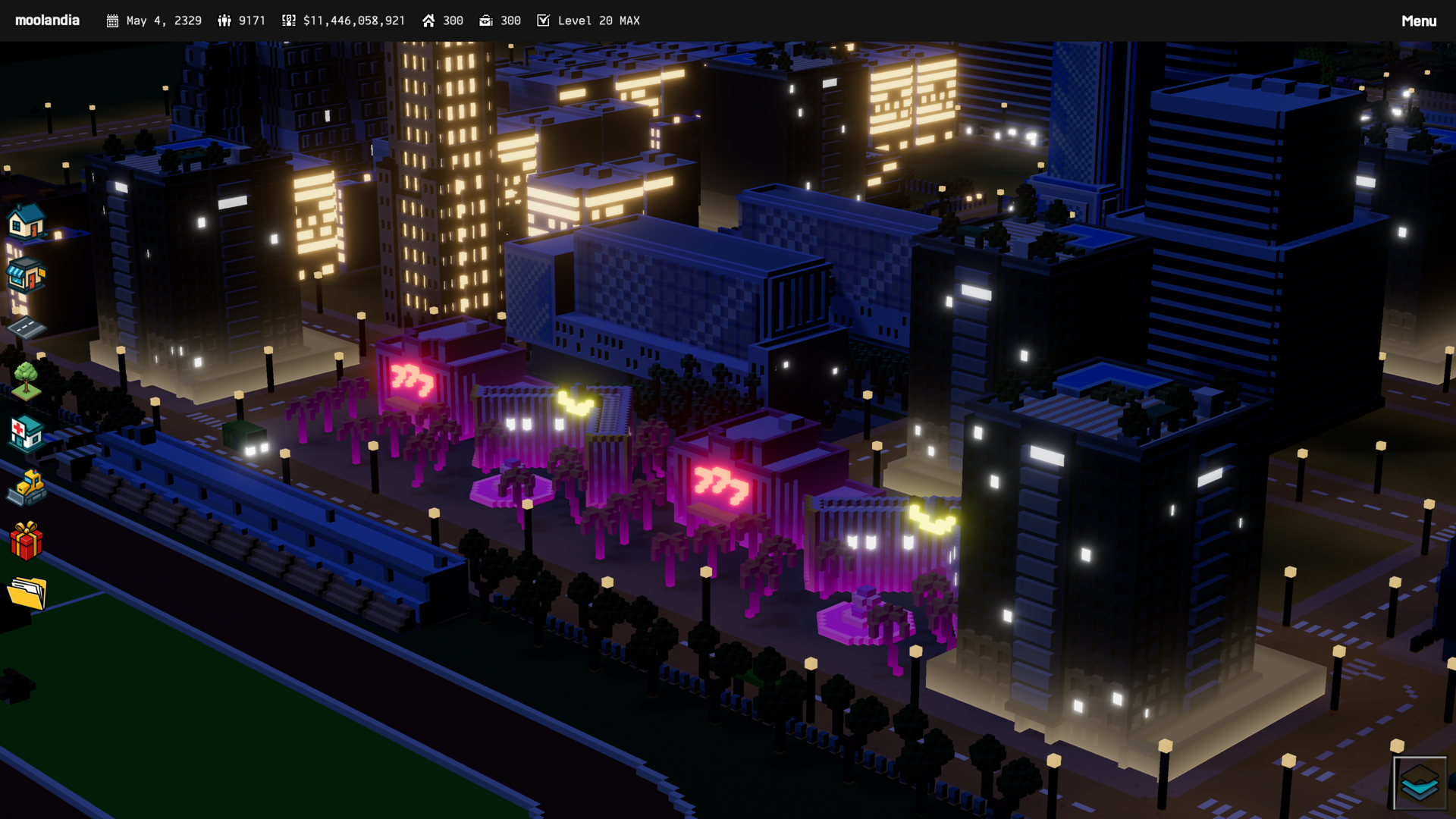
Some tourists are whales. They show up rarely but spend millions. The more tourism aura your city puts out, the more likely you attract one. This is not a reward for good play. It is a fat-tailed distribution, the kind where one visitor can make more money than a hundred regular ones. - Casinos no longer need a gift to unlock. They come in three looks now, glow magenta at night, and pull in tourists on their own (+5 tourism aura). The neighbors still hate them (+2 disapproval). That is the casino deal. Revenue that comes with resentment attached.
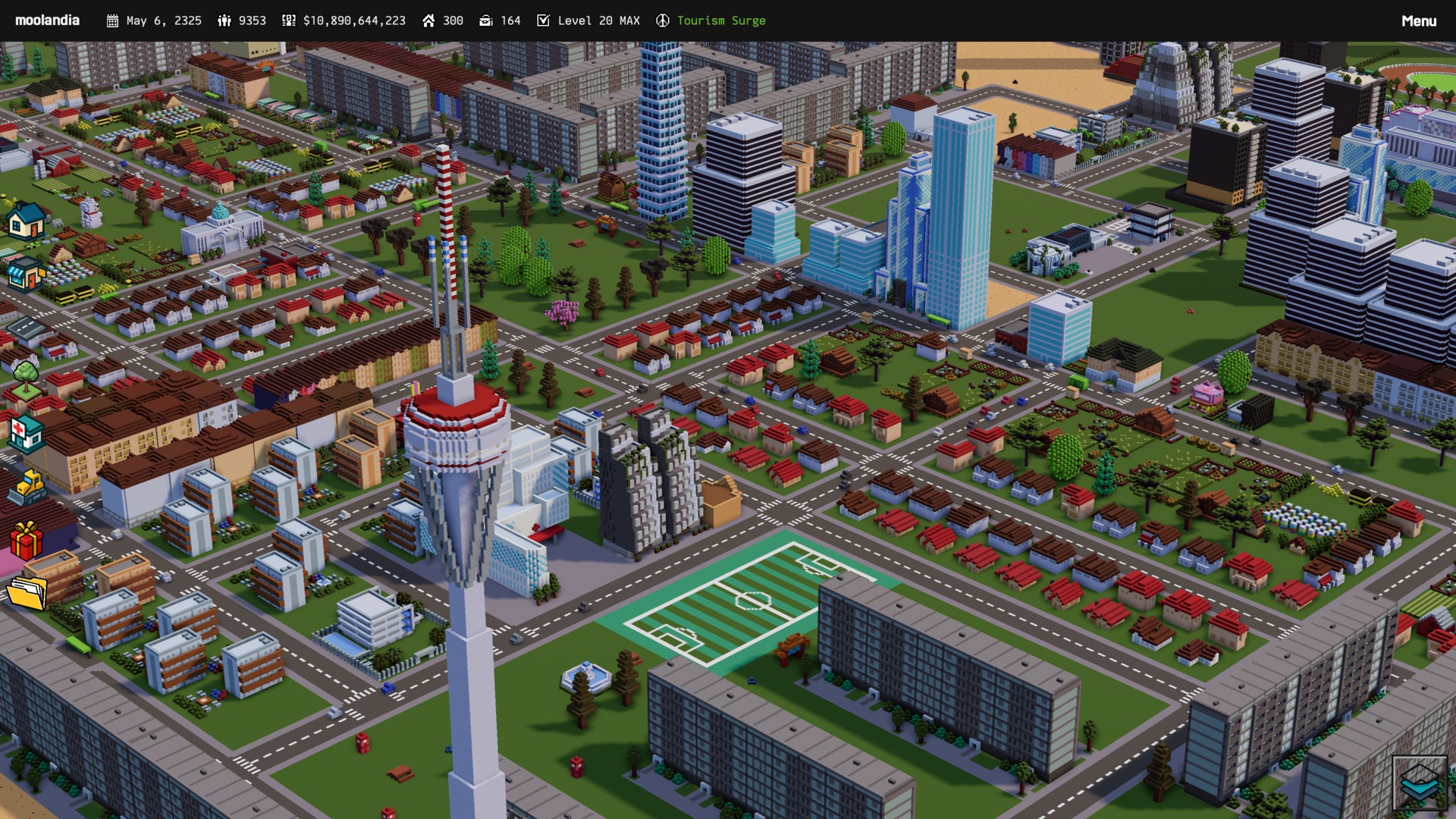
Cosmo Tower now costs $30M and puts out 20 points of tourism aura. It used to be free and decorative, which was generous and not realistic. - Cat Cafe now attracts tourists (+2 aura), because of course it does.
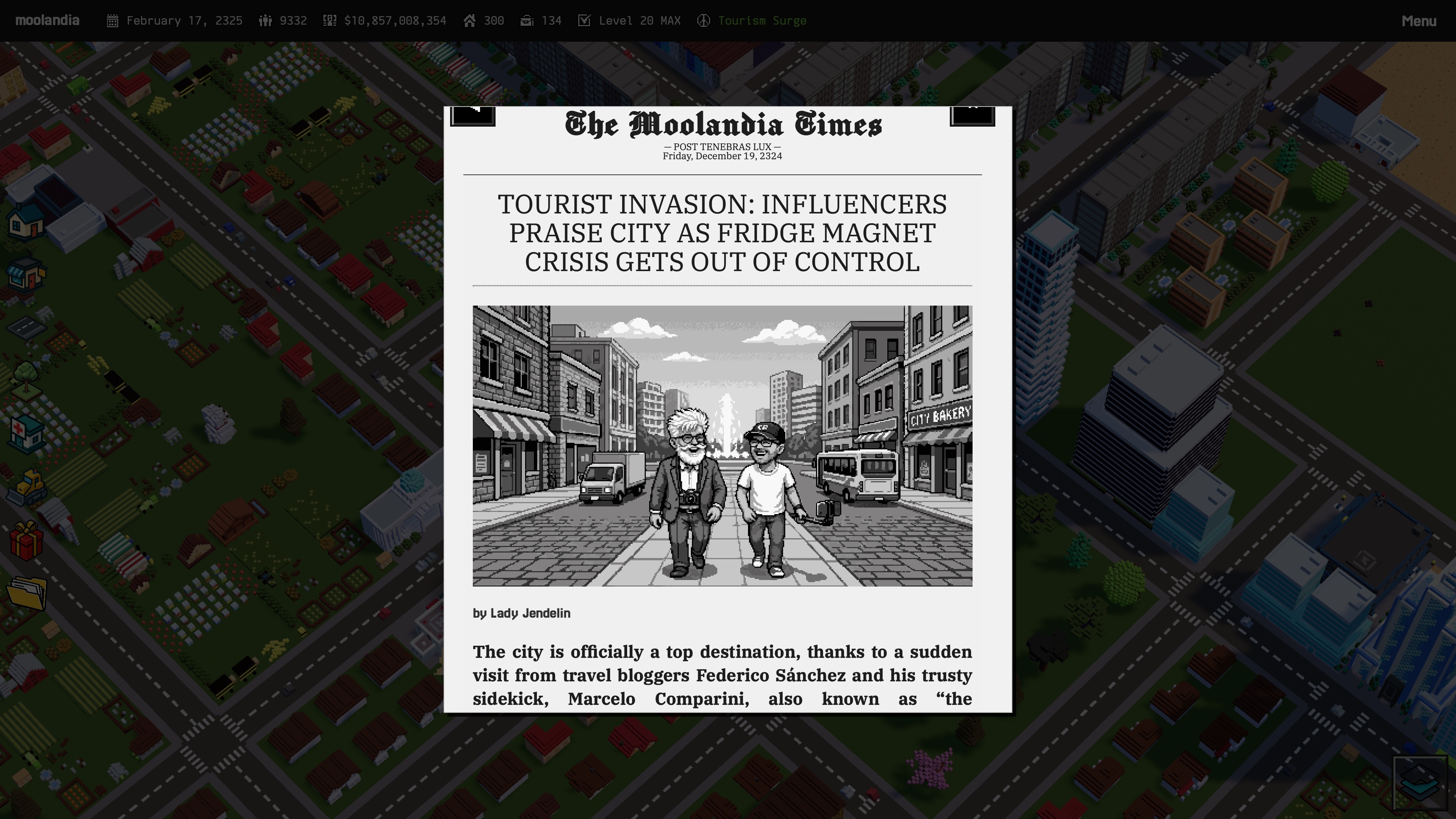
Casino and racetrack bets are capped at $1M. The sim was letting citizens bankrupt themselves in a single evening, and that was happening. - Tourism surge event now doubles daily arrivals instead of boosting revenue. Make sure you have beds when it hits, or watch the money walk past your city.
- Pandemics freeze tourism completely. No tourists, no exceptions, no hotel revenue. The income stream you built your budget around can vanish overnight. That is why you should not build your budget around it.
New region: Campara
A new region selector on the title screen lets you pick your starting conditions before you commit. Think of it as choosing how much pain you want.
- Alborina is the classic 64x64 map. Nothing changed, your muscle memory still works.
- Campara is 128x128, four times the area (6.55 km²). It starts you $100M in debt at 6% interest over 10 years, because ambition has a price. You unlock Campara by reaching level 20 in any city. You need to prove you can run a small city before the game lets you ruin a large one.
- Loan repayments show up as a new line in your budget report. The bank does not care about your approval rating.
- We will add a third region very soon that will be unlocked by reaching level 20 in Campara.
Rent prices that know where they are
Every building now has a quality tier: basic, standard, or premium. Every residential building gets scored on four things: disagreement aura from neighbors, crime rate, park access, and walkable services like schools, shops, hospitals and police stations. Bad scores push rent down. Good scores push rent up. This is hedonic pricing, from Rosen's 1974 paper "Hedonic Prices and Implicit Markets". The idea is simple. A good's price is the sum of its parts, not a single number. An apartment is not just square meters. It is square meters plus safety plus walkability plus the absence of a factory next door.
- Commercial rent varies by industry. Finance pays more because margins are higher. Hospitality pays less. This changes where companies want to set up.
- Landlords pass about 70% of the property tax to tenants. Raising the land value tax raises the cost of living. Policy has consequences, and this one is well documented in real housing markets.
- Leases lock in rent at move-in. The asking price can keep rising but the tenant pays what they signed for until they leave. Longtime tenants can pay less than newcomers in the same building. That is how it works in the real world too.
- Moves are now tagged: forced (eviction, demolition), responsive (rent burden, bad neighborhood), or voluntary (upgrade by choice). The displacement mechanics come from O'Flaherty's 1995 economic theory of homelessness, where housing loss is not a personal failure but a market outcome. And from Desmond and Shollenberger's 2015 research on forced displacement from rental housing, which showed that eviction is not a rare event but a regular feature of low-income neighborhoods. You can now see what is displacing people and why. That is more than most real mayors can say.
- Two new stats. Monthly GDP uses the income approach: wages plus profits plus rent. Displacement Rate shows the share of households forcibly displaced each month. Anything above 0.5% per month means a housing crisis. If you see that number climb, something you built or failed to build is pushing people out.
Everything else that changed
Happiness is now a spectrum, not a checkbox: The scale changed from 0 to 5 to -6 to +6. Six factors, each worth +1 or -1: shelter, job, safety, basic needs, parks, healthcare. A homeless unemployed citizen in a dangerous city with no parks and bad hospitals scores -6. Approval points are now just the count of citizens with positive happiness. A city of 1000 happy people earns 1000 points monthly. A city of 10,000 miserable people earns zero. Size does not make up for dysfunction.
Most buildings no longer need a level to unlock: If you have the money and the demand, build it. Leveling now unlocks gifts and regions. We removed the gate because it was punishing players who knew what they were doing.
Immigration finally makes sense: Unfilled specialist jobs like teacher or doctor now reserve immigration slots for workers with the right profession.
New event: Cultural Boom: Cultural venues attract twice as many immigrants for the duration. Build the museums first, benefit later.
Demand and growth rebalanced: Demand points now use a two-tier system. Above 80% occupancy you get 25 points per month. Above 20% you get 10. Below 20% it stops.
Four new languages: Italian, Portuguese, Simplified Chinese, and Japanese. Spanish and French moved from beta to stable.
Quality of life: You can drag to bulldoze whole areas instead of clicking tiles one by one. Buildings under construction show scaffolding that grows floor by floor. The toolbox grays out buildings you cannot afford and tells you why. Clicking demand icons opens the right chart directly. Camera tilt works with arrow keys in WASD mode, no extra keys needed. Stats panel updates live. Unemployed citizens post on LockedIn looking for work, because even simulated people need the indignity of a job platform. Previously retired park gifts are back. Many small things that add up to a game that respects your time.
Performance and stability: Many small optimizations to graphics and simulation that add up to a much smoother experience, especially in large cities.
Bug fixes: Dozens of them. This is the single minor update with the most bug fixes in our history.
Tourism is the part of a city's economy that depends entirely on people who do not live there, making choices you cannot control, based on impressions you can only partly shape. In 1.8 that dependency is visible for the first time. Occupancy bars on hotels, spending flows through retail, whale arrivals that rewrite your quarterly revenue. The tourists are real now. Whether your city is ready for them is a different question, and the one that actually matters.
Leave a comment
Log in with itch.io to leave a comment.